About the Project
Evaluating multi-species interactions to inform Indigenous-led caribou habitat restoration in fire-prone landscapes
Canada’s boreal forests are under increasing pressure. Industrial activities like logging and oil and gas development, combined with increasingly frequent and intense wildfires, are leading to habitat loss and changes in ways that negatively impact both wildlife and the northern communities that depend on these ecosystems for food, water, and cultural continuance.
Boreal caribou are a culturally important and iconic Canadian species distributed across northern Canada and depend on boreal forests for survival. Caribou are unique in that they depend heavily on lichen as a food source, which is very slow to recover following disturbance, making caribou especially sensitive to habitat changes. Despite decades of management efforts, boreal caribou are listed as threatened under the federal Species at Risk Act (SARA), and their populations continue to decline. Current management has leaned heavily on expensive, short-term emergency responses such as predator control, maternal penning, and conservation breeding that don’t address the underlying problem: the habitat itself is degraded. My research asked whether restoring that habitat (i.e., repairing it to a state close to its pre-disturbance condition through reclamation practices) can be done effectively, offering a longer-term solution. Recognizing that habitat reclamation practices, such as replanting, are expensive, I aim to identify which restoration approaches work best, given that conservation resources are never unlimited.
Working in partnership with Fort Nelson First Nation (FNFN) in northeastern British Columbia, who have led on-the-ground restoration across their traditional territory since 2019, this research tracks how different restoration treatments affect both wolf and caribou movement behaviours across my study region. This is done by using GPS data from collared animals, along with camera traps and ecological surveys, to try to evaluate which restoration practices are most effective. This work is done in partnership with FNFN Guardians and Lands staff, where generations of place-based knowledge of this landscape have guided research questions in ways that remote or institution-based teams could not have done on their own. FNFN is already using findings to guide the ongoing identification of restoration priorities, and results are being shared through community-based dissemination methods, making them accessible and impactful.
Ultimately, this project has reminded me that conservation is not just a technical challenge, but a social one. The most effective research does not happen in isolation, but in meaningful and reciprocal relationships. When Indigenous communities, government partners, industry, and research work together from the very beginning, the outcome is not just better science, but science that gets used. FNFN is not just a collaborator, but the creator of this work because the land, the caribou, and the outcomes of this work matter deeply to the community. Meaningful partnerships with local communities and stakeholders change what kind of questions get asked, how data is collected, and ultimately what impact is possible. I hope this work will demonstrate that scientific research aimed at producing meaningful, applied outcomes remains rigorous and valuable, and that research should be designed to serve community priorities, leading to more long-lasting outcomes than work designed solely to advance academic careers.
About the Award Recipient
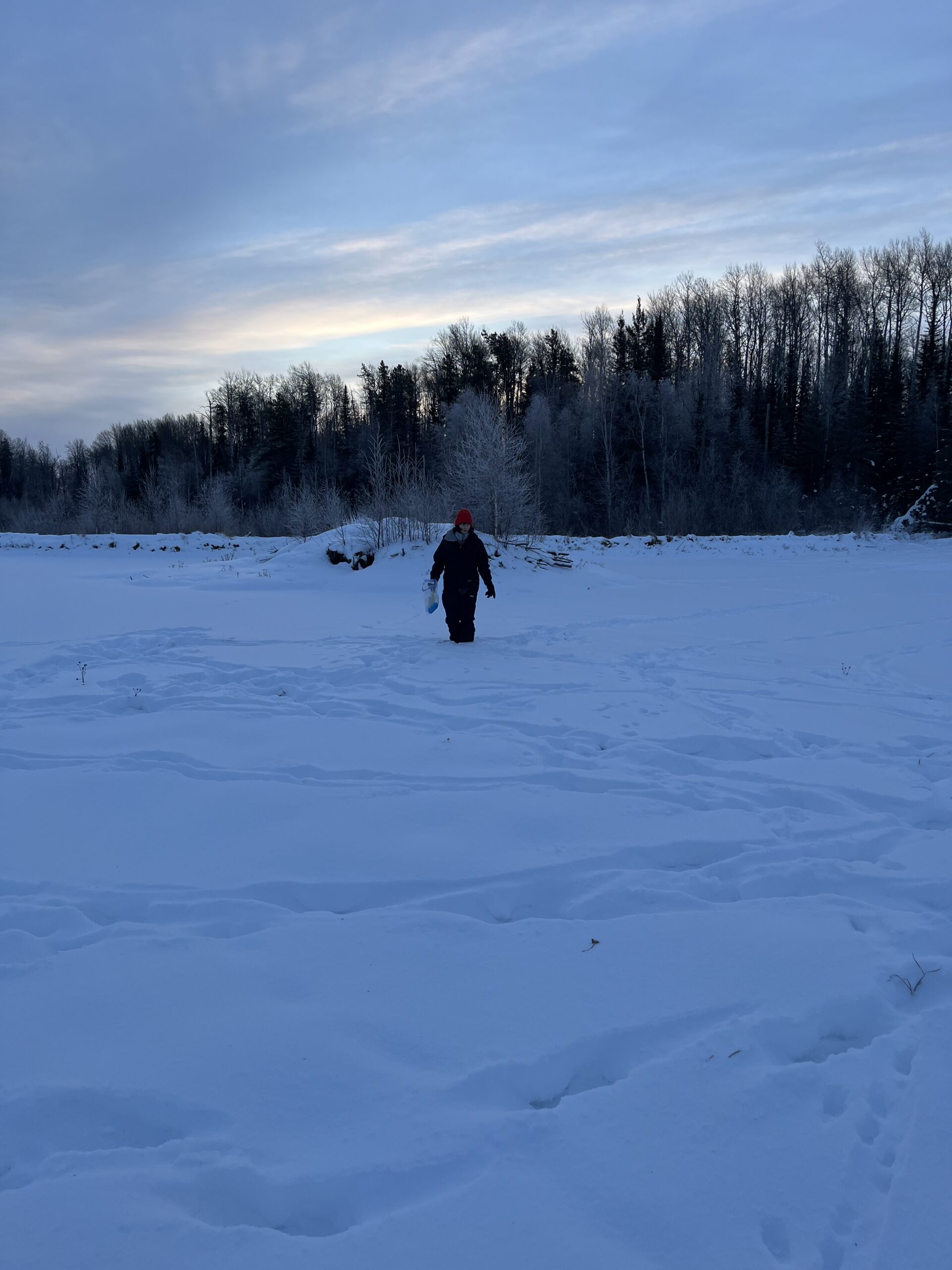
Margaret Hughes (She/Her): I am currently a Postdoctoral fellow in the Department of Biological Sciences at the University of Calgary, where I also recently completed my PhD, working on boreal caribou conservation in northeastern British Columbia in partnership with Fort Nelson First Nation and SwampDonkey Solutions. My research focuses on wildlife behaviours and how habitat restoration can shift predator-prey dynamics, supporting indigenous-led land stewardship in fire-altered landscapes.
Growing up on a small-scale farm, I witnessed firsthand how research could fail to reach the people it was designed to help, shaping a core value guiding my research design: meaningful research must be accessible to and co-created with the people it directly impacts. Above this, as a woman in science navigating a male-dominated field built around extensive fieldwork, I have experienced how structural barriers can limit access to opportunities and shape whose voices are heard in research. This has made me deliberate about centring diverse perspectives in research design and outcomes. Additionally, as a university-educated settler conducting research on Indigenous lands, I recognize the privilege my academic position affords me. My collaboration with Indigenous groups, specifically Fort Nelson First Nation, has taught me the care, humility, and reciprocity required to build partnerships that genuinely center community priorities rather than extract knowledge for academic outputs. These lived experiences collectively ground my understanding that impactful research requires genuine collaboration, accessibility, and respect for diverse ways of knowing.
Outside of research, you can find me outdoors with my collection of pets, or in the field capturing pictures of the animals I have the privilege of watching, a reminder of how lucky I am that this became my job.